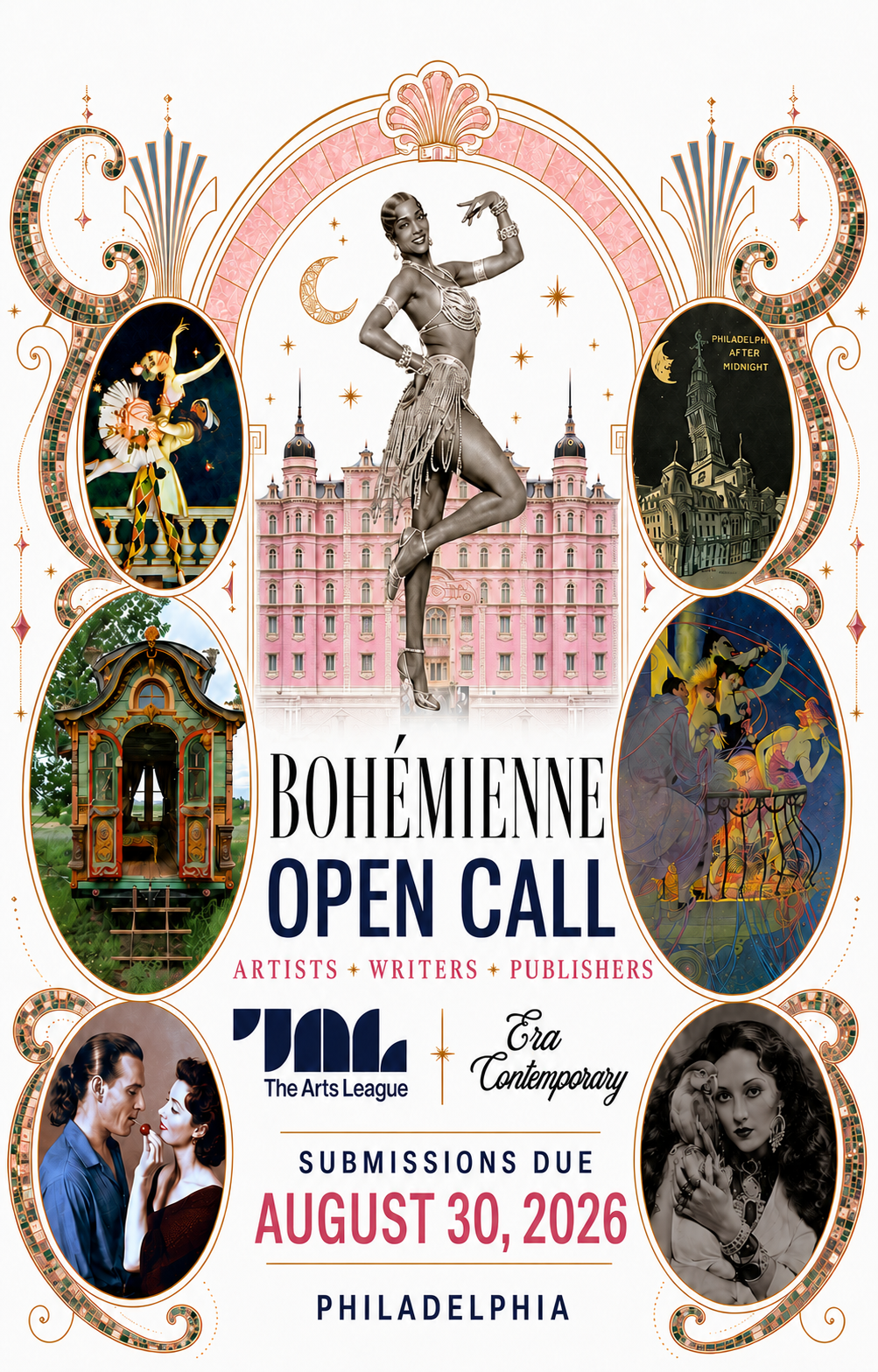
BOHEMIÉNNE: a group exhibition at the Arts League of Philadelphia curated by Jo Gamel and Jessica Libor, open to visual artists, writers and publishers.
This is a physical exhibition to be exhibited at the Arts League of Philadelphia.
Important exhibition dates:
Submission deadline: Sunday, August 30, 2026 | 11:59 PM
Notifications sent by: Friday, September 11, 2026
Drop off window: Monday–Wednesday, September 21–23, 2026, 11 to 3pm each day at the Arts League of Philadelphia
Exhibition on view at the Arts League of Philadelphia: October 2nd- October 22nd, 2026
Opening Reception: October 11, 2026 | 5:30–8:30 PM
Closing reception: Thursday, October 22, 2026
Deinstallation: Friday–Sunday, October 23–25, 2026
Statement from the curators:
Bohémienne exhibition explores Bohemia as a transhistorical state of mind: a timeless creative ethos where freedom, beauty, imagination, and artistic courage transcend convention. Bringing together visual art, literature, and print culture, the exhibition traces this enduring spirit from nineteenth-century Paris and Poe's Philadelphia to contemporary artists and writers who continue to shape culture through lives devoted to creative expression.
The term Bohemian entered European languages in the 15th century as the French word Bohémien. The French believed that the Romani people had come from the Kingdom of Bohemia (now part of the Czech Republic), although this was historically incorrect. Because of this mistaken association, bohémien came to signify someone who lived outside conventional society.
By the nineteenth century, the meaning shifted dramatically. Rather than referring to ethnicity, at this time it came to mean artists, poets, musicians, writers, actors, and intellectuals who deliberately rejected bourgeois values in favor of creativity, beauty, intellectual freedom, romance, and communal living.
The decisive moment came in 1845 when the French writer Henri Murger wrote Scènes de la vie de Bohème, romanticizing the artistic and unconventional life in Paris's Latin Quarter. Murger's stories became one of the defining myths of the modern artist.
Those stories later inspired La Bohème, Moulin Rouge!, and Rent, among many other works of art.
Bohémienne exhibition goes beyond decorative style or a historical period into its deeper underpinnings of self-invention and resistance to prescribed ways of living.
Bohémienne moves across history as a prism scattered across different geographies but bound together by a spirit of striking creativity: from Kafka’s Prague and Josephine Baker’s Paris to Jimi Hendrix’s electric San Francisco and Edgar Allan Poe’s Philadelphia, and the countless creatives inspired by the concept. These places and figures form a constellation of Bohemia, linked by the instinct to create a life and artistic body that is unconventional. This exhibition brings together mixed-media, multidisciplinary, and multitalented artists whose work resists singular definitions of practice, identity, beauty, or success.
Examples of Bohemian painters are Henri de Toulouse-Lautrec, who lived among performers and cabaret entertainers in Montmarte, Paris and who is famous for his free-flowing paintings and lithographs depicting the energetic showbiz lifestyle that were used on so many showbills at the turn of the century. Suzanne Valado was one of the first major female painters to emerge from Montmarte's Bohemian community, beginning as an artist's model for Renoir, Degas, and Toulouse-Lautrec before becoming a celebrated painter herself. She embodied artistic independence long before women were widely accepted as professional painters. Edgar Degas, although more of a bougeois personally, documented the world of dancers and performers that defined Parisian Bohemia in his sketches and paintings. Pierre-Auguste Renoir's paintings of cafe's and outdoor gatherings helped crystalize the social atmosphere of artistic Paris, such as Luncheon of the Boating Party. Vincent van Gogh became the ultimate symbol of the artist living outside conventional society, his letters revealing his mindset of complete dedication to artistic truth.
Writers associated with the Bohemian ideal are Edgar Allen Poe, especially in his Philadelphia years, for his counter-cultural way of living and writing. Oscar Wilde, Anais Nin, Bram Stoker, and Mary Shelley all epitomized unconventional choices and exploration of the deepest underpinnings of the imagination in their works.
In music, the famous performer Josephine Baker transformed her stage presence into a curated icon of Bohemia, and Edith Piaf penned songs of love and longing that resonate with us even today. David Bowie, Jimi Hendrix and Florence Welch exemplify more current interpretations of a bohemian presence.
Across centuries, the Bohemian is an archetypal figure who chooses imagination over conformity and beauty over utility. The idea of the Bohemian transcends the city of Paris and extends to a way of creating that appears wherever artists, writers, musicians, and visionaries gather to invent new ways of living and making. Bohémienne exhibition asks what becomes possible when patterns of convention are interrupted, rearranged, or abandoned. The past inspires new compositions, painted with freedom, collaged and illuminated through contemporary experience.
The works move along a spectrum of discipline and abandon, private ritual and collective life, transgenerational inheritance and chosen identity. Together, they form a kaleidoscope rather than prescribing a single definition or submitting to one authority of taste, correctness, or value. Bohemianism emerges as an instinctual impulse toward self-authorship: the freedom to define one’s own measures of beauty, achievement, belonging, and success. It is the freedom not merely to break the rules, but to recognize that many of them were never immutable, and to author the terms of one’s own life.
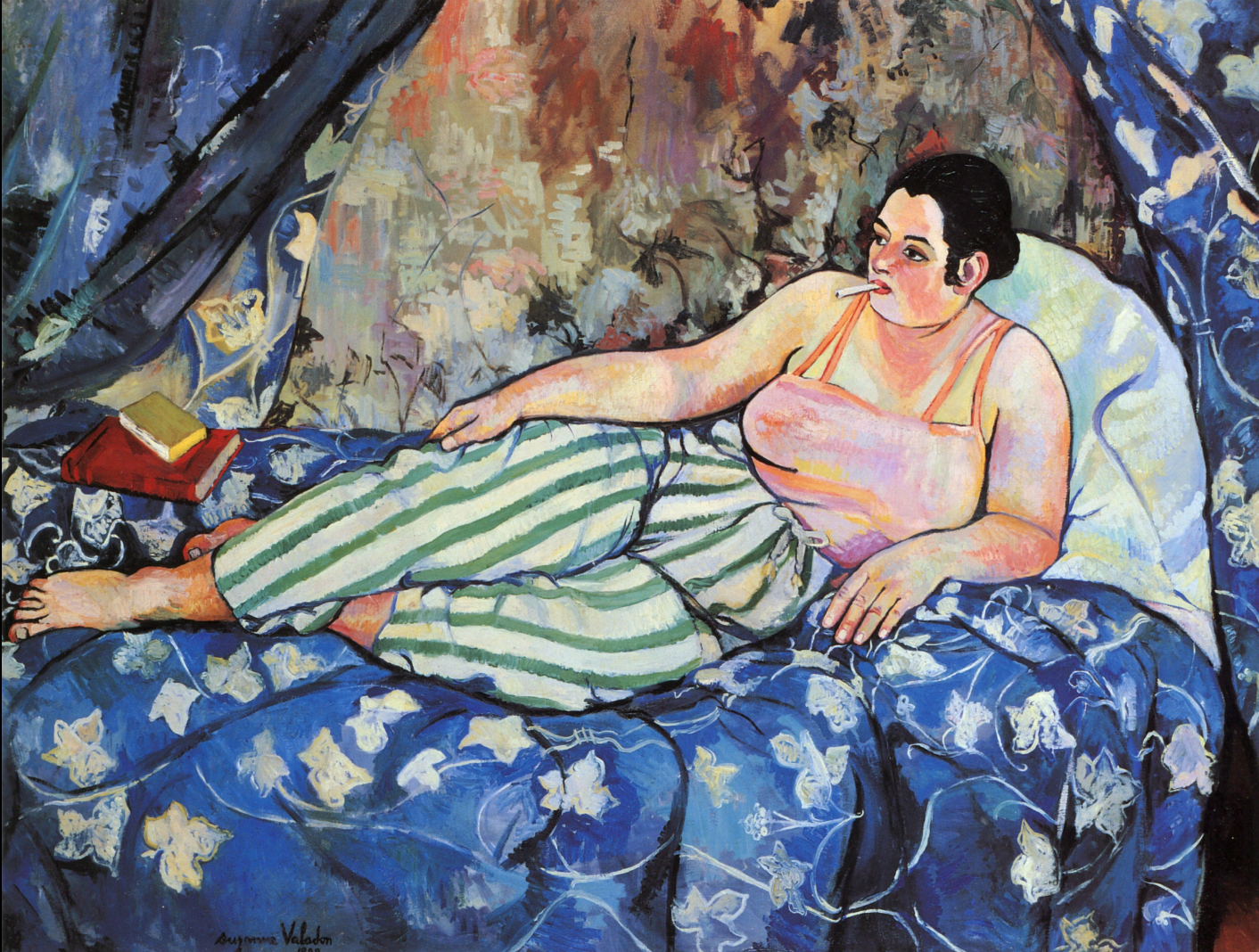
Featured artwork: The Blue Room by Suzanne Valadon, public domain.
About the Arts League of Philadelphia: Founded in 1967 by West Philadelphia artists, arts advocates, and neighborhood residents, The Arts League of Philadelphia has grown into one of the city's longest-standing community arts organizations. Housed in a historic Victorian building on Spruce Street, the nonprofit provides visual and performing arts education, exhibitions, artist residencies, workshops, and cultural programming for all ages. Committed to accessibility and creative opportunity, The Arts League champions emerging and established artists while fostering artistic exchange across diverse communities. For nearly six decades, it has served as a vibrant hub where education, exhibition, and community engagement intersect, enriching Philadelphia's cultural landscape through the transformative power of the arts. The exhibition will be held at the Arts League of Philadelphia at 4226 Spruce Street, Philadelphia, PA 19104.
About the curators:
Jo Gamel
Jo Gamel’s pluridisciplinaire practice ponders medicine as a cultural system as much as a clinical one.
Education and internships in formal medical study reshaped her understanding of authority, diagnosis, and care.
Gamel depicts natural specimens against Enlightenment architecture, situating living forms inside historical frameworks of reason, to create eerie, dramaturgical altars of miracle, perception, and dismissal in whimsically layered mixed-media, polychromatic palettes, academic brushwork, and magical realism.
Jo Gamel lives and works in Philadelphia, Pennsylvania. She earned her BFA with high honors from Moore College of Art & Design, where she received the Emerging Leaders In The Arts scholarship and the Excellence in Painting Award, which fully funded her study abroad of Eastern Baroque architecture in St. Petersburg, Russia. Gamel has also received several honors, including the Women in Art Excellence Award from Artio Gallery in London, and First Place and Best in Show at the Art Is Cool contest. Gamel has exhibited her work internationally at institutions such as the Louvre (Paris, during Paris+ Art Basel), Chelsea Old Town Hall (London, during London Art Week), the European Museum of Modern Art (Barcelona), and twice at Philadelphia’s Magic Gardens museum. She is an alumnus of the residency program Governor’s School of the Arts. Her work is held in private collections in Seattle, Portland, Los Angeles, New York City, Philadelphia, Ankara, Stockholm, and Gothenburg, and has been featured in Create! Magazine, Killer Magazine, and a full-color front page feature in the Salem Sunbeam newspaper.
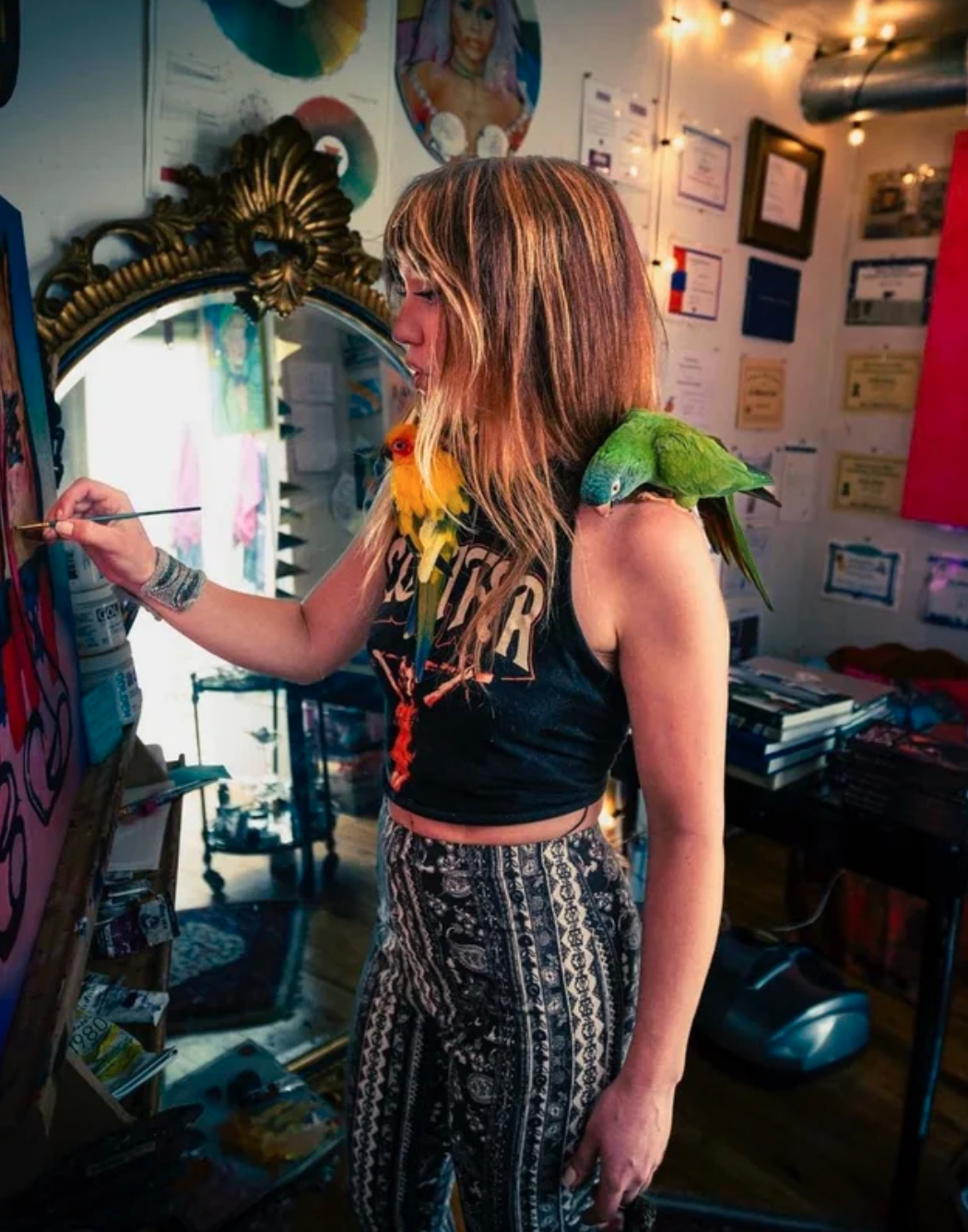
Jessica Libor
Jessica Libor (b. 1987) is an American artist whose work explores themes of feminine identity and the transformative power of storytelling in the creation of personal mythology. She earned her Master of Fine Arts from the Pennsylvania Academy of the Fine Arts in 2014 and has pursued further classical training at the Grand Central Atelier and the Florence Academy of Art.
Based in Philadelphia yet active in New York, Libor has maintained an active studio practice since completing her MFA. Her artistic vision is deeply informed by narrative and symbolic traditions, drawing particular inspiration from global fairy tales—a recurring motif throughout her work. Artist residencies have played a pivotal role in this exploration; in 2022 and 2023, she participated in several residencies in Scotland and France, experiences that enriched her engagement with myth and folklore. Her most recent artist residency was Spring 2026 at the Akureyri Art Museum in Iceland, where she researched Nordic mythology.
In 2023, Libor presented her work in two solo exhibitions: her international debut at La Serre Wangari in Paris, France, and a stateside show at Look Listen Gallery in Philadelphia, PA. She was also selected to exhibit in the SPRING/BREAK Art Show in New York City in 2025 and most recently exhibited her solo show and curatorial project She in the Tower in May 2026 in Brooklyn, NYC.
Her work is held in private collections internationally and has been exhibited in numerous institutions, including the Independence Seaport Museum, the Louisiana Art and Science Museum, the Pennsylvania Academy of the Fine Arts, and the Masonic Library and Museum. In addition to her visual art practice, she is the host of The Creative Heroine Podcast, where she explores the intersection of creativity, storytelling, and the feminine spirit.